
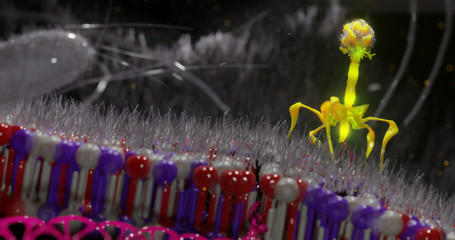
A new study from Mostowy’s lab in Poland on “Structural modularity of receptor-binding proteins underlies host-range strategy diversification in Klebsiella pneumoniae phages” shows the importance of using structural modelling in determining phage-bacterial interactions.
Bacteriophage receptor-binding proteins (RBPs) determine bacterial host recognition and are central to phage host-range evolution, yet the structural principles governing how RBPs diversify and expand host range remain not fully understood. Although phage RBPs are thought to evolve through modular exchange of receptor-binding domains, it is unclear how this modularity is organised across diverse RBP architectures, at what structural scales recombination operates, and how it shapes host-range breadth. Here, we combined large-scale AlphaFold3 structural modelling, domain-level annotation, de novo pseudo-domain segmentation, sequence modularity analysis, and experimentally determined host-range phenotypes across 192 Klebsiella pneumoniae phages and 382 high-confidence RBPs, spanning up to 96 K-types. We generated the first system-wide structural atlas of K. pneumoniae phage RBPs, resolving 39 structurally distinct RBP classes. Although capsule-degrading beta-helix depolymerases dominated numerically, 161 RBPs across 37 RBP-classes employed non-depolymerase architectures, including 18 novel RBP-classes. Structural and sequence analyses show that this diversity arose through modular reuse of structural domains rather than independent invention. Conserved N-terminal scaffolds linked depolymerase and non-depolymerase RBPs across morphotypes, while receptor-binding regions diversified through recombination operating at and beyond domain boundaries. We found recent modular exchange both within genera, where capsule-specific and capsule-independent RBPs can be swapped to alter host-range strategy, and across morphotypes, where depolymerase modules moved between distant lineages, altering capsule specificity. Together, these architectures resolve into six receptor-recognition strategies, establishing multi-scale modularity as the primary organising principle of RBP diversification and a structure-informed framework for guiding phage isolation and engineering against K. pneumoniae. The complete atlas is freely accessible as an interactive community resource at Klebsiella-Phage-RBP-Atlas.
https://www.biorxiv.org/content/10.64898/2026.05.12.724579v2

