
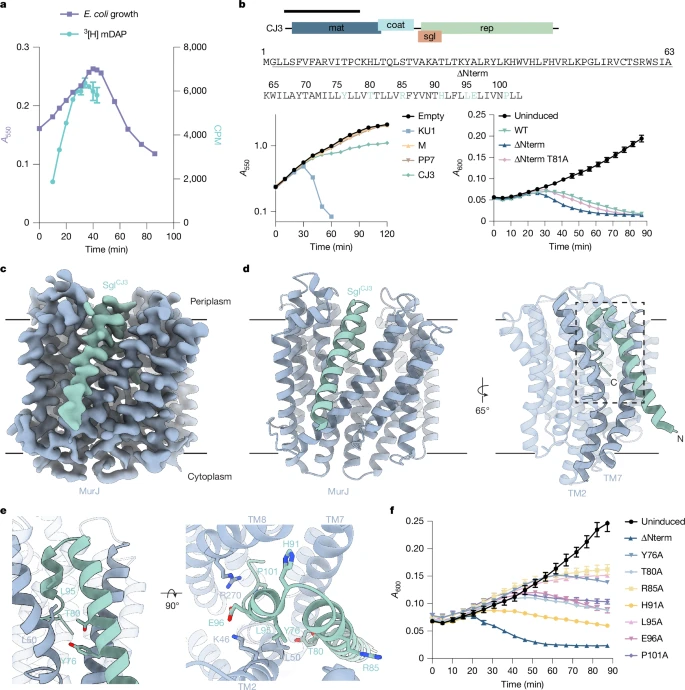
A new study published in Nature shows that three lysis proteins in small RNA phages inhibit bacterial growth by blocking the MurJ (lipid II flippase) in PG synthesis.
Highlights: Antimicrobial drug resistance is a major global health issue, underscoring the need for new druggable targets. The lipid II flippase MurJ is a promising target in bacterial cell wall biosynthesis. Currently, the only known inhibitors of MurJ in Gram-negative bacteria are the single-gene lysis proteins (Sgls) from the phages M (SglM) and PP7 (SglPP7), which, despite having different evolutionary origins and sequences, share a common inhibitory mechanism. In this study, we examined the structures of MurJ bound to SglM and SglPP7, and we characterized a third inhibitor, SglCJ3, from the predicted phage Changjiang3. Our results show that all three Sgls converge to trap MurJ in a periplasm-open conformation through a shared interaction site, paving the way for new drug design strategies.
Read here: https://www.nature.com/articles/s41586-026-10163-w
 PHAGElogist