
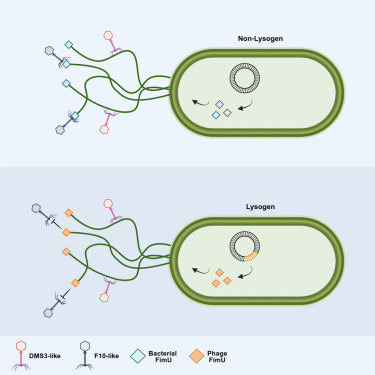
A prophage-expressed type IV pilus component provides anti-phage defense
https://www.cell.com/cell-reports/fulltext/S2211-1247(25)01531-1
Summary: Phage genomes integrated into bacterial genomes, known as prophages, frequently encode proteins that provide defence against subsequent phage infection. These proteins often function by altering the cell surface and preventing phages from attaching to their host receptor. Here, we describe prophage-encoded proteins that resemble FimU, a component of the Pseudomonas aeruginosa type IV pilus. These phage FimU proteins are incorporated into the pilus without altering its function, yet they confer robust protection against phage infection by binding to the pilus tip, where FimU is located. The phage FimU proteins and the phage tail proteins that likely interact with FimU are highly diverse, suggesting that evolution in this system is driven by phage versus phage competition. These phage FimU proteins represent an example of anti-phage defense mediated by the replacement of a bacterial cell surface component with a phage-encoded protein.
 PHAGElogist