
A new study published in eBioMedicine, “Efficacy of precisely tailored phage cocktails targeting carbapenem-resistant Acinetobacter baumannii reveals evolutionary trade-offs: a proof-of-concept study“
https://www.sciencedirect.com/science/article/pii/S235239642500386X
Summary
Background
The rapid emergence of phage-resistant bacterial mutants and the challenge of developing tailored phage cocktails have significantly hindered the broad application of phage therapy. This is particularly critical for infections caused by highly prevalent strains such as capsule locus 2 (KL2)-type carbapenem-resistant Acinetobacter baumannii (CRAB) in China.
Findings
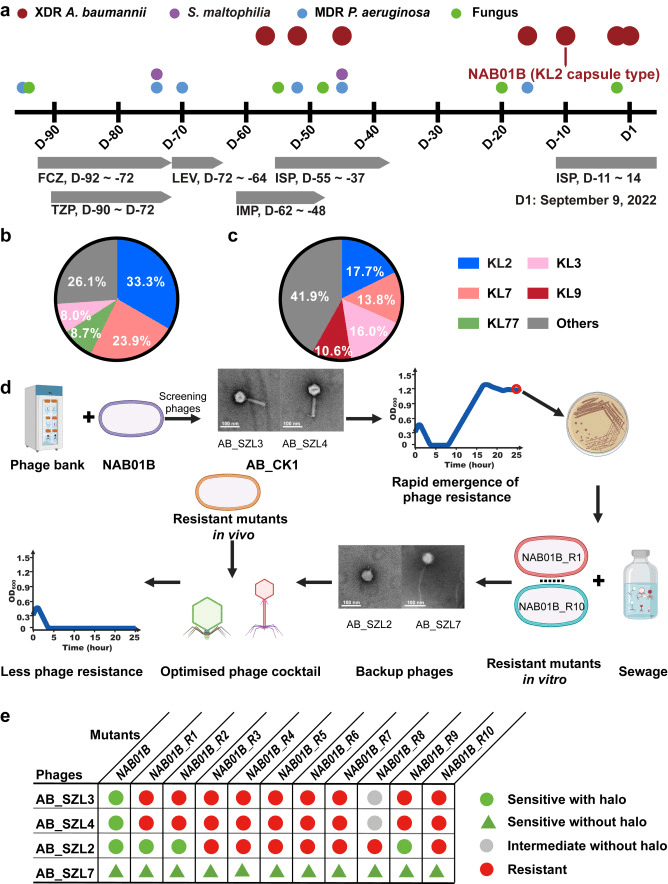
KL2-type A. baumannii was the predominant lineage, accounting for 17.7% (159/896) of isolates reported across China over the past five years, and 33.3% (46/138) of clinical CRAB isolates obtained by our laboratory from five hospitals and one institute in Guangdong Province. The optimised phage cocktail effectively targeted 89.1% (41/46) of these KL2-type isolates. The phage-resistant A. baumannii mutants exhibited beneficial trade-offs, including increased antibiotic sensitivity, reduced virulence, susceptibility to immune clearance, and impaired biofilm formation. Genomic analysis revealed that these trade-offs were driven by concentrated and consistent mutations in genes involved in the biosynthesis of lipo-oligosaccharide and capsular polysaccharide. Crucially, the application of this cocktail in two clinical cases of CRAB infection demonstrated both clinical efficacy in resolving infections and a favourable safety profile.
Interpretation
This research highlights the potential of rationally designed phage cocktails, developed through strategies such as iPAS, to address the growing threat of CRAB infections. The successful clinical application highlights the translational impact of this study. Furthermore, the study provides valuable insights into the co-evolutionary dynamics between bacteria and phages, paving the way for broader and more effective clinical applications of phage therapy.
 PHAGElogist