
Publication coming soon…
Holins
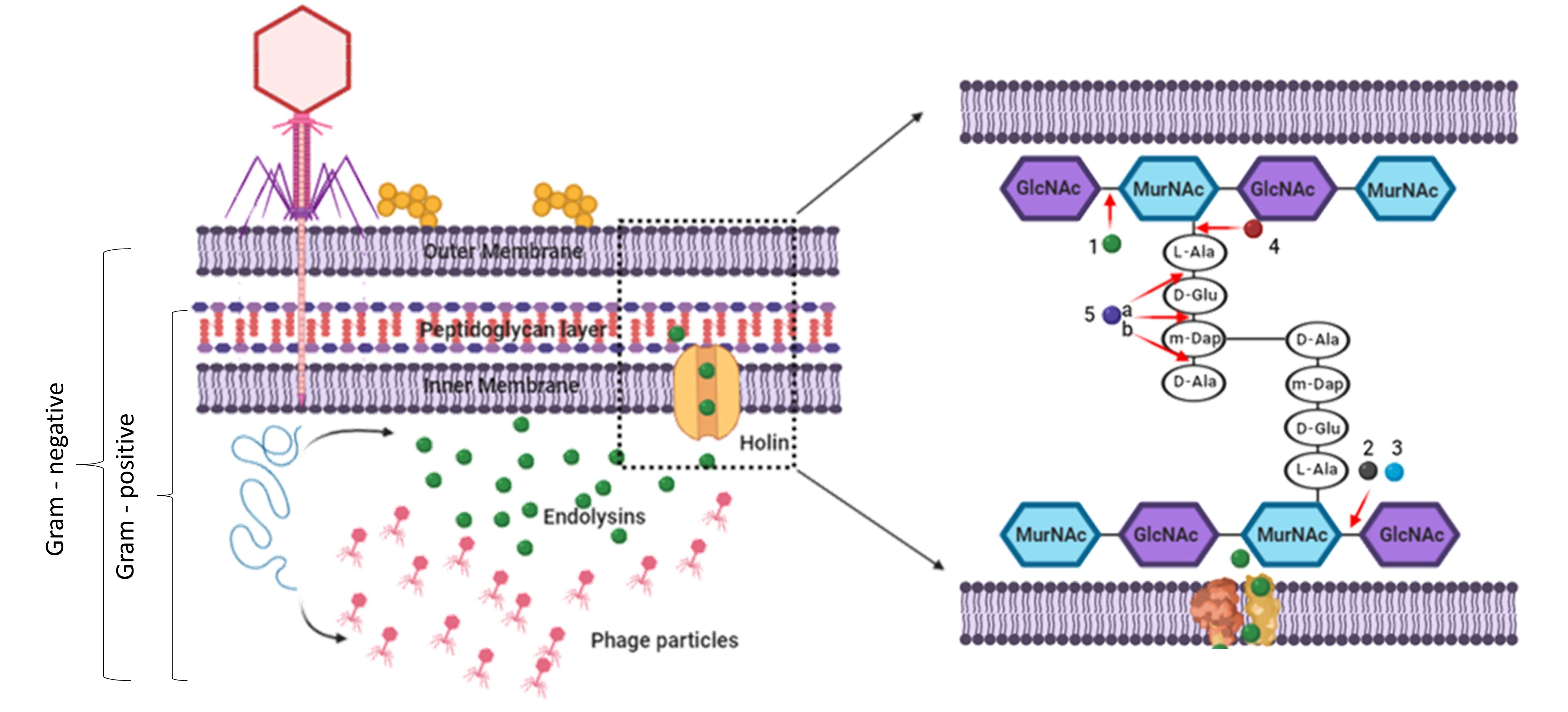
As a part of the lytic system of dsDNA phages, holins play two fundamental roles: they create holes in the inner membrane for the release of the endolysins, and determine the timing for the end of the infection cycle. Holins accumulate in the inner membrane of the cell with no effect on its integrity until they reach the critical concentration that triggers holin activation. Two types of holins have been described: canonical holins that form large pores and pinholins that form small pores.
Holins can cause cell death independent of endolysins and, unlike these, have a broad-spectrum unspecific antibacterial activity against both Gram-positive and Gram-negative bacteria [58]. These features have attracted interest towards the application of holins in bacterial control, although perhaps limited to disinfection of surfaces or foodstuff due to the lack of specificity [58]. For applications requiring specificity, it may be possible to fuse holins to a peptide that specifically binds to the target bacteria, since fusion has been shown not to affect holin activity [59]. For this purpose, CBDs of endolysins and phage RBPs may be an option.
 PHAGElogist