
Direct interactions between bacteriophages and mammalian cells
Despite growing interest in phages’ role in shuttling material among bacteria, some of the biggest recent developments in research on phages in the human gut have turned out not to involve bacteria at all. One of the key pieces of this particular puzzle was fitted by University of Utah microbiologist June Round and her colleagues, who as part of a phage therapy study a few years ago fed several types of Caudovirales phages to mice that were genetically predisposed to certain types of cancer and had been infected with a strain of E. coli known to increase that risk. “The premise was pretty simplistic,” recalls Round. “It was just to identify a cocktail of phage that would target bacteria that we know drive chronic colorectal cancer.”
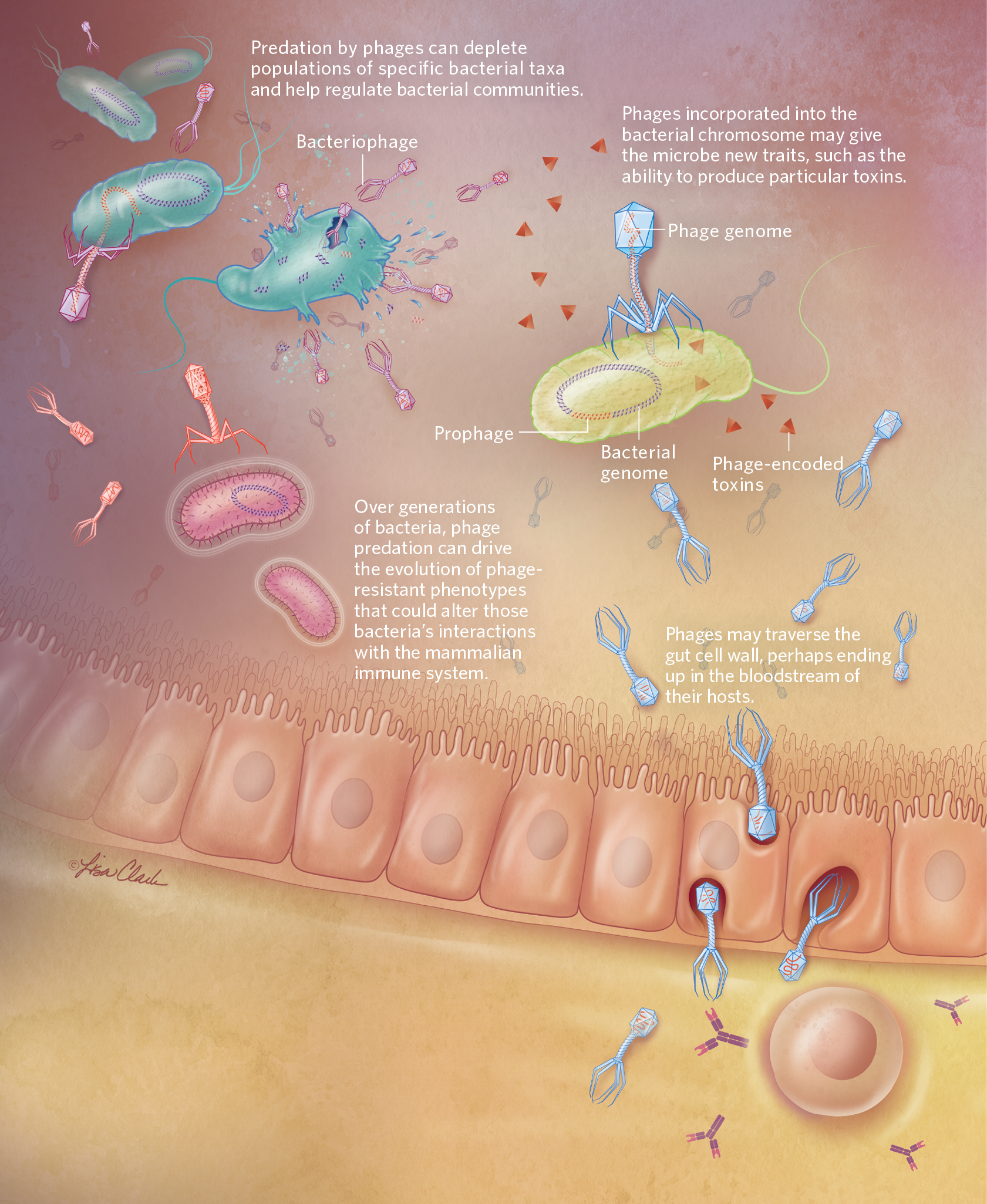
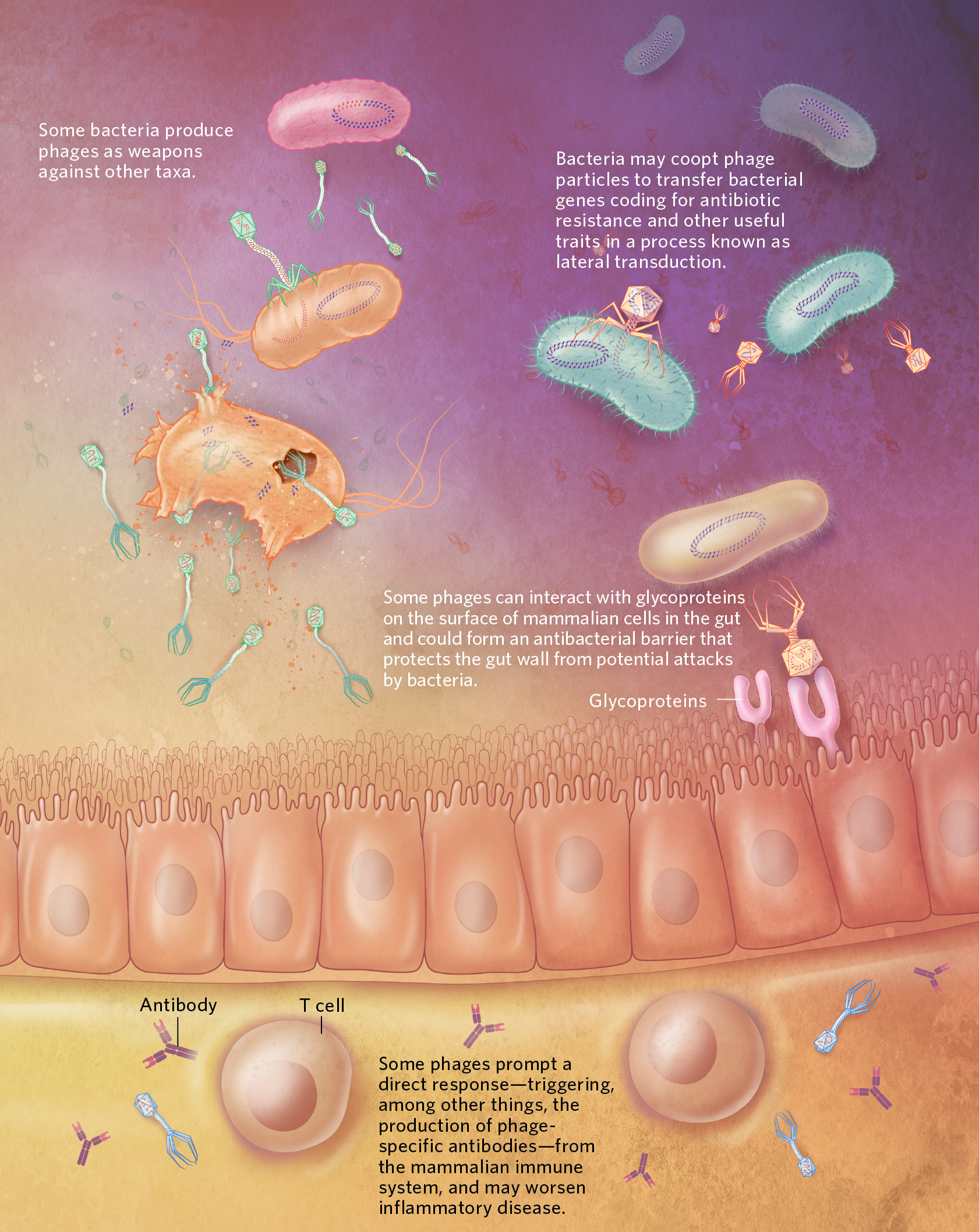
The team was surprised to see that the phages, despite being viewed by most researchers as exclusively bacteria-attacking entities, prompted a substantial response from the mice’s immune systems—mammalian defenses that should, according to conventional wisdom, be indifferent to the war between bacteria and phages in the gut. Intrigued, the researchers tried adding their phage cocktail to mice that had had their gut bacteria completely wiped out with antibiotics. Still, they saw an immune response. It was then, Round says, that “we realized that [the phages] were likely interacting with the immune system.”
Exploring further, the team found that the phages were activating both innate and adaptive immune responses in mice. In rodents with colitis, the phages exacerbated inflammation. Turning their attention to people, the researchers isolated phages from ulcerative colitis patients with active disease, as well as from patients with disease in remission and from healthy controls, and showed that only viruses collected from patients with active disease stimulated immune cells in vitro. And when the team studied patients who received fecal microbiota transplantation—an experimental treatment for ulcerative colitis that involves giving beneficial gut bacteria to a patient to try to alleviate inflammation and improve symptoms—the researchers found that a lower abundance of Caudovirales in a recipient’s intestine at the time of transplant correlated with treatment success.
By the time the team published its results in 2019, a couple of other groups had also documented evidence of direct interactions between phages and host immune systems. Meanwhile, Duerkop, Hooper, and colleagues reported that mice with colitis tended to have specific bacteriophage communities, rich in Caudovirales, that developed in parallel with the disease. Many of the types of phage they identified in the intestines of those diseased mice also turned up in high abundance in samples taken from the guts of people with inflammatory bowel disease, the researchers noted in their paper, supporting a possible role for phages in the development of disease.
Round says that researchers are still unsure about exactly why these trans-kingdom interactions are happening—particularly when it comes to host adaptive immune responses, which tend to be specific to a particular pathogen. She speculates that mammalian hosts might derive a benefit from destroying certain phages if those phages are carrying genes that could aid a bacterium with the potential to cause disease. Exactly how immune cells would detect what genes a phage is carrying isn’t yet clear.
Meanwhile, hints of collaboration between eukaryotic cells and phages have cropped up in the work of several other labs. One recent study of a phage therapy against P. aeruginosa found that phages and immune cells seem to act in synergy to clear infections in mice. Other work has indicated that phages bind to glycoproteins presented by cells along the mucosal surfaces of the mammalian gut and may provide a protective barrier against bacterial pathogens—a relationship that some microbiologists have argued represents an example of phage-animal symbiosis. Duerkop adds that there’s evidence emerging to support the idea that phages in the mammalian intestine not only can be engulfed by certain eukaryotic cells, but also might slip out of the gut and into the bloodstream to make their way to other parts of the body, with as yet undiscovered consequences.
Whether these mechanisms can be exploited for therapeutic purposes remains to be seen, but Round notes that they do raise the possibility of unintended effects in some circumstances if researchers try to use phages to influence human health via the gut microbiome. At least in the type of chronic inflammatory diseases she and her team have been studying, “we might just be making it worse” by using phages to target disease-causing bacteria, she says, adding that all research groups studying such approaches should take into account potential knock-on effects. Considering phages’ multiple interactions, with both bacteria and animal cells, she says, “it’s a lot more complex than what we’d appreciated.”
 PHAGElogist